

By Chuck Ness
Like our sins that go away, never to be brought up again by God, so too is Barabbas to history. Neither Christian nor Jewish writings ever mention Barabbas again. Barabbas was the scapegoat which was released into the wilderness, so that the Levitical ceremonial law of sacrifice could be fulfilled by Christ. The word scapegoat means something entirely opposite from what it meant at the time the King James version of the Bible was wrote. Today the word scapegoat means something entirely opposite from what it meant at the time the King James version of the Bible was written. Today, the word is used mostly in sports, politics, or business when an individual or group unfairly get blamed for the faults, mistakes, or problems of others. Humans are always looking to blame someone for things that went terribly wrong, thus the scapegoat gets the blame.
And Aaron shall cast lots on the two he-goats; one lot for Jehovah and the other lot for a complete removal. And Aaron shall bring the goat on which Jehovah’s lot fell, and offer it for a sin offering. But the goat on which the lot fell to be the complete removal shall be presented alive before Jehovah, to make an atonement with him, to let him go for a complete removal into the wilderness. Leviticus 16:8-19
However, when we think of the time the Jews demanded Barabbas be set free and Jesus be crucified for crimes he did not commit, we see Jesus as the ultimate “scapegoat,” fulfilling the Old Testament Day of Atonement ritual where sins were placed on a goat and then sent into the wilderness. In Jesus case, HE not only symbolically, but literally took humanity’s sins and guilt upon Himself through His crucifixion, acting as the perfect, sinless sacrifice to bear the punishment for all people, thus removing our burden of sin so we can become the righteousness of GOD in Him. So while Jesus became the scapegoat in a modern sense of what a scapegoat is, like Judas, we are free of the sin, thusFor He made Him who knew no sin to be sin for us, that we might become the righteousness of God in Him. 2Corinthians 5:21
Therefore when they were gathered together, Pilate said to them, Whom do you desire that I release to you? Barabbas, or Jesus who is called Christ? …………… They said, Barabbas. Then he released Barabbas to them. And when he had scourged Jesus, he delivered Him to be crucified. Matthew. 27:17-22
From the moment Adam and Eve rejected God for the World, God had a plan for how man could be reconciled with Him. God was preparing his people in the Old Testament for the coming of Jesus and as such the sacrificial system was getting his people into the mindset that the blood is what makes atonement for sin. Jesus tells us;
“Do not think that I came to destroy the Law or the Prophets. I did not come to destroy but to fulfill. For assuredly, I say to you, till heaven and earth pass away, one jot or one tittle will by no means pass from the law till all is fulfilled. (Matthew 5:17-18)
Something many do not know, is that Barabbas’s name literally means son of the father. Bar means son – for example, Simon Bar-Jonah meant Simon, son of Jonah; Abbas or abba means father. So too we are sons (genetically speaking) of our Father in heaven (Rom. 8:15). Thus, we see that the example of Barabbas teaches us, among other things, the high price paid for us to be sons and daughters of our Father – sons and daughters set free from deserved death – by the price of the blood of our elder brother, Jesus the Messiah.
Yom Kippur is the Jewish feast otherwise known as the Day of Atonement. It is observed on the 10th day of the 7th month (Lev 23:27). It is atonement for Israel. Just like all the other six feasts it is prophetic and fulfilled in the Lord Jesus Christ! This is the most important date on the Hebrew calendar. The celebration is observed by using two goats.
A careful examination of Leviticus 16:8-10 gives us a inspired understanding of the scapegoat offering. On this day one goat is for the Lord, the other is for the scapegoat. One goat is put to death, the other shall go free. One goat represents substitution, the other the carrying away of sins.
“Then Aaron shall cast lots for the two goats: one lot for the LORD and the other lot for the scapegoat, and Aaron shall bring the goat on which the LORD’s lot fell, and offer it as a sin offering, but the goat on which the lot fell to be the scapegoat shall be presented alive before the LORD, to make atonement upon it, and to let it go as the scapegoat into the wilderness.” (Leviticus 16:8-10)
No doubt the Old Testament Jew knew the symbolic meaning of the Day of Atonement. They were looking to be spared another year. A sigh of relief surely expelled out of them as they saw the scapegoat set free. The Lord’s goat had been slain and the blood applied to atone the nation.
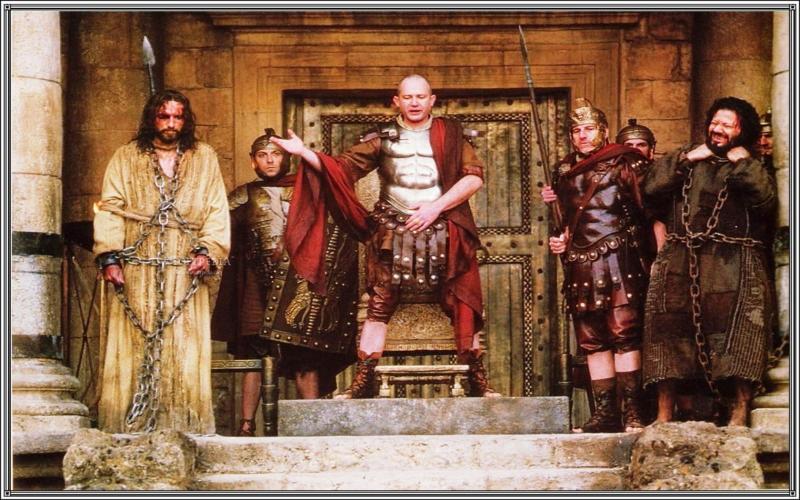
Now, let us fast forward about 1400 years to Pilate’s Court. Jesus of Nazareth has been wrongfully accused by his own countrymen of blasphemy. The religious leaders of Israel bring him before the Roman governor Pontius Pilate that he may be punished for his accused crime.
Pilate’s examination of Jesus Christ finds that he has done nothing wrong, so he decides to release him. The mob has no part of it. They make threats if Jesus is not condemned. Pilate’s plan changes as he sees the envy within the mob. He gives them a choice of which prisoner they would have go free at Passover: Jesus of Nazareth or Jesus Barabbas. Barabbas, a infamous bandit in Jerusalem, The Priests had their choice of who they could set free. Jesus The Christ, or a man who is mentioned in all four gospels as a well know murdering thief who was guilty of sedition against against both Rome and Jewish rule.
Matthew called him a notorious prisoner. So Barabbas was well-known throughout the region. He was like their Bonnie and Clyde, Billy the Kid, of the day. Barabbas was hated and feared by all. (Matthew 27:16)
Mark referred to Barabbas a murder. He was one of the rebels who revolted against the Jewish religious leaders and Pilate. In their revolt they murdered people.(Mark 15:7)
Luke also wrote that Barabbas was thrown in prison for a certain rebellion made in the city, and for murder. (Luke 23:19)
John called Barrabbas a robber. (John 18:40)
In the end, the Chief Priests made their choice: and they chose Jesus Barabbas as the scapegoat. Jesus as we know was the Fathers goat. Barabbas goes free and Jesus Christ goes to Calvary. Hallelujah, the real Day of Atonement has come to Israel!
What about me and you? Where does our lives fit into this story? Well, you and I are the scapegoat. We are Jesus Barabbas. Jesus Christ died as our substitution on Calvary. The Lord’s goat is slain, while the scapegoat goes free. The Word of God tells us “who the son has set free is free indeed.” (John 8:36) Next time you think about God and eternal life, remember that scapegoat, because you an I are Barabbas.







Leave a Reply