


In my morning meditation, I pondered the life of Isaac.
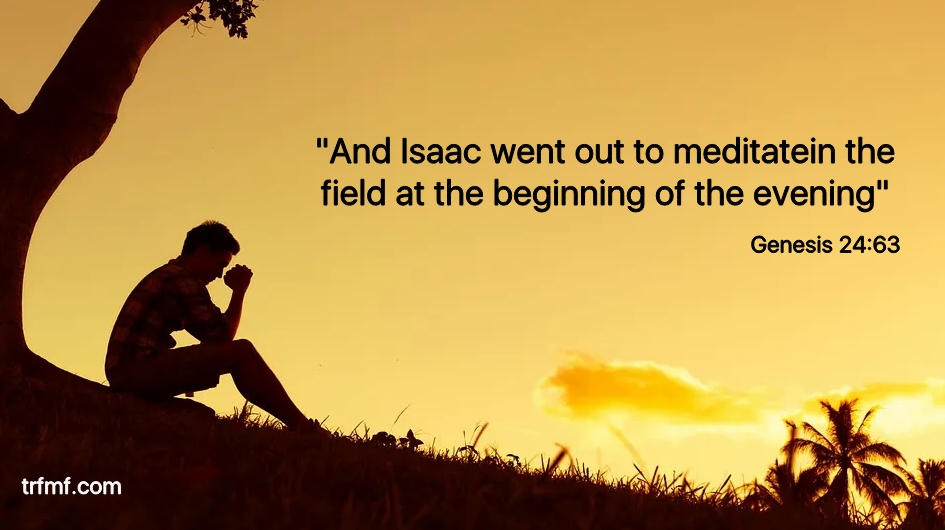
As I did, I realized that not much is written of his life. We have over 15 chapters that cover his father Abraham’s life. Then there are 13 chapters that cover his son Jacob’s life and exploits. However, we have but less than 2 chapters about Isaac. Yet as an old preacher wrote many years ago, we can get an idea of Isaac’s character from just a portion of the following verse;
“”And Isaac went out to meditate in the field in the evening; “ (Genesis 24:63)
What follows was written by Mark G. Pearse, a Cornish Methodist preacher and author who lived from 1842-1930
After the death of Abraham, God blessed Isaac. What a contrast meets us as we turn to him. The longest lived of the patriarchs, yet what a little space he fills. Abraham has many chapters — so has Jacob, but Isaac has scarcely a single chapter to himself, this is the lesson of his life.
We talk of most men because of their importance. I want to talk of Isaac because of his unimportance. His are the annals of a quiet life. God is the God of Abraham. Yes, we do not wonder at that — Abraham the hero, the warrior, the father and founder of great nations — the man of such gifts and such achievements.
But God is the God of Isaac, too — the God of the quiet uneventful life. The heavenly Father hath room in His heart for all His children. He who makes us to differ, loves us in all the separateness of our character.
The advantages of such a quiet unassuming life certainly has more room for meditation. If it knows fewer things, it generally knows them better and deeper. If it has less glory and triumph, it has closer and steadier communion. If it cannot fight the Master’s battles, it can sit at the Master’s feet and learn of Him. The quiet life has its blessings.
Down by the stream the little meadow lay; and it heard afar off the roar of the great city, and it saw the ruddy glare of its lights flung up against the murky sky.
“Alas!”
it sighed,
“how dull a life is mine! Yonder, in the city, with its thousands, one might do some good. But I am so far away and useless.”
But in the night time came the stars and sang to it —
“Foolish creature, we are thine in all our silvery brightness, we whom they scarcely see in the city.”
Then the dew fell and whispered to its heart —
“And I am thine, I that am of no use on the hard city ways.”
And up rose the sun and woke the flowers and painted them afresh, and it said —
“I am thine, I who have to fight with city fogs for many an hour yonder.”
And the meadow thought it had something to sing about after all, and the lark went soaring heavenward with music. But one day it heard some stray city sparrow tell a tale about the hungry little children, and the drunken men, and the wretched women, and about weary rich folks. And it grew sad again and said —
“What can I do down here, out of the way, and so common-place?”
Then came the breeze and it cried in a hurry,
“Quick! give us your freshness and fragrance that we may bless the crowded courts and streets,”
And it was off. And there came some that picked the flowers from beside the stream, and told how they should gladden many a weary heart, and smile upon sick children, and light up many a dreary home. Then the meadow sang a sweeter song than ever, and was glad that He who makes all has so much room for the quiet and unknown, and can turn these to such good account.
God blessed Isaac.
Mark G. Pearse






Leave a Reply